Wednesday, May 14, 2014

What Makes Brandie Frommelt's Bikram Yoga Studio Special?


Brandie Frommelt's Bikram Yoga studio has only the best of the best when it comes to Bikram yoga teachers.  Bikram instructors undergo intense training, and must be certified before they can teach.  The instructor has to be able to recite, verbatim, the Bikram dialogue for the entire 90 minute class.  And of course, they must be qualified to teach the 26 postures and the two breathing exercises.

Image Source: wellandgoodnyc.com

It is important that the instructors know what they are doing.  Bikram yoga can be very challenging and intense, even for the most physically fit athlete.  This type of yoga not only takes a combination of strength, balance, and flexibility, but Bikram yoga is performed under extreme conditions.

Image Source: bikramyogasaltlakecity.blogspot.com

The class is held in a room that is heated to 105 degrees with 40% humidity.  This high heat warms the muscles, allowing for a deeper and safer workout.  It also serves to remove toxins from the body, prevent injuries, reduce stress, promote relaxation, increase blood circulation, improve strength and flexibility, and it helps to heal any injuries you may have.  It also teaches the body to use oxygen properly.  Bikram yoga can even reduce the symptoms of many chronic diseases, such as arthritis, if practiced regularly, at least three times a week.  It will also result in an increase in muscle tone and strength, and eventually even weight loss. Mentally, Bikram yoga can increase clarity and concentration.

Image Source: bikramyogatri-cities.com

It may seem dangerous to do any kind of exercise under such conditions, but as long as you stay well hydrated and you don't have a serious medical condition, it is safe.  This is another reason it is important to have a certified Bikram instructor running your class – they know how to keep you safe, as well as knowing how to help you reap the most benefit from this popular type of yoga.

Monday, April 21, 2014

REPOST: Yoga for runners: A hot look at yoga

Runners are turning to hot yoga for pain and injury management. This article on Trail and Ultra Running is a runner’s first-hand account of how Bikram yoga has enhanced and improved his running practice.
After several years of competing in endurance sports, I found myself dealing with regular overuse injuries that often sidelined me from training. Those injuries included lower back problems, inflammation, patella tendonitis, plantar fasciitis, and issues with the IT band. With every one of those injury episodes, I suffered a bit of depression because it was not my choice to take the time off and it seemed every injury was poorly timed with respect to key races or developing fitness.

The great change in my training came with the introduction of regular yoga practice. It was my friend, Lorraine, who first suggested I visit her Bikram Yoga studio in San Diego. After some admirable persuasion on her part, I decided to join her for a 90 minute session in beginner’s yoga. My first few sessions were very intense, to say the least. I was challenged but also developed a profound interest in yoga as it related to my primary sports of ultrarunning and triathlon. Unfortunately, I didn’t continue practicing yoga and I slipped back into my former methods of running, biking, and swimming to extremes. It was several years later, after my move to Colorado, that I found myself injured again from ultrarunning.  A massage therapist was actively working on my IT band and during our discussion, she suggested I give yoga another try. Out of complete frustration for the injuries that continued to sideline me from mountain running, I researched a local Hot Yoga studio and walked into the lobby one day with an open mind. That was about 4 years ago. Since that day, I have made “hot method” yoga a regular part of my endurance training.  In that time, I have gained some real perspective with regard to why you should consider yoga as well.

I am grateful to have found yoga and made it a regular part of my busy life because it keeps me healthy in mind and body. Basically, yoga keeps me on the trail and ready to tackle mountain miles on a daily basis. There are several reasons I would suggest ultrarunners consider yoga:

First off, I have not had any overuse injuries since I began practicing yoga.  The nagging running injuries that sidelined me years ago like IT band tightness, lower back pain, and runner’s knee are just distant memories.  If I feel anything in my body that amounts to a possible running injury, I visit the studio and get my 90 minutes of practice.  On almost every occasion, the pain subsides within 24 hours of my session and I regain my regular training as if it never happened.

I’ve developed greater flexibility in my entire body. This is one of the physical benefits of regular yoga practice. This greater flexibility allows for more fluid trail running and allows me to feel smooth in my turnover. No doubt, it also helps alleviate other types of injuries one might suffer during rugged trail running. Realize that my knees, ankles, legs, hips, and back absorb the damage from ultra distance running because I undo that damage in the yoga studio. This has become quite obvious throughout the past few years when I include more yoga in response to the mileage increases or races during my season. I would also share that balance, core strength, and breathing are greatly improved through regular yoga practice.

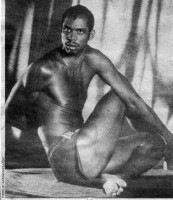
I personally enjoy the stress reduction of a well timed yoga class. This helps me sleep better and clears my mind to write poignant articles for Trail and Ultrarunning (wink wink). One of the most successful professional basketball players of all time was Kareem Abdul-Jabbar. In fact, he is considered to be one of the best of all time. It was Kareem’s longevity in the sport that allowed him to obtain incredible records like playing 1,560 games (2nd most in NBA history) and career NBA all time records for most points, minutes played, all star games, and free throws. (1) Many don’t know that Kareem played all those years (1969-1989) and practiced regular yoga throughout. His career outlasted most by a decade!  Kareem once shared his thoughts about yoga saying, “As preventative medicine, it’s unequaled. Once I started practicing it, I had no muscle injuries during my career. Yoga can help any athlete with hip joints, muscles, tendons, and knees. Plus, it keeps you in touch with your body.”

NBA All-Star Kareem Abdul-Jabbar demonstrates “spine twist”
Image Source: trailandultrarunning.com
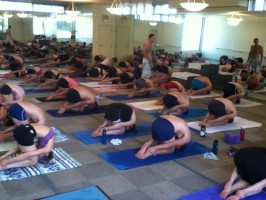
Lastly, for those of you who know little to nothing about yoga, I want to share a little about what yoga practice is like in the traditional “hot method” or “Bikram Yoga” style. I know it was a complete unknown when I first walked into the studio. Sometimes it is just the unknown that keeps people away. Let me share a little about what happens during my typical 90 minute practice… My local studio here in Westminster Colorado is called “Hot Method Yoga”. The studio provides a schedule which I access online. They have a variety of classes to include the standard beginner class as well as more advanced yoga classes. They allow walk-ins or you can schedule ahead. The standard “beginner” practice is designed to be standardized, so every class is presented pretty much the same way. Classes begin precisely on time when the instructor enters the room. Every student has a yoga mat and towel. The instructor then talks students through a series of breathing exercises which include postures in “standing position”.  The movement of arms and elbows increase lung capacity, which is beneficial for many reasons.

Students performing “rabbit pose” at Hot Method Yoga in Westminster, CO
Image Source: trailandultrarunning.com
 The first 20 minutes are considered a warm up and several more postures are introduced. Each posture brings students to a static position for 10 seconds to 1 minute. There is an effort to maintain stillness in most postures. The only sound in the room is often breathing. From there, we move to the floor where we do a series of standardized postures on our mats. From the toes to the head, every part of the body is warmed up and gradually introduced to deeper postures. New students are always welcome to stop and lie down if they are overwhelmed for any reason. The only thing asked of new students is that they remain in the room so the instructor can make sure they are OK. Between floor postures, students may lie in savasana or “dead body pose” which is basically complete stillness. This allows the body to recover and absorb. The length of time spent in savasana is dependent on the type of posture completed. Toward the end of the 26 postures, a series of floor postures provide excellent opportunity for you to stretch your IT band, especially with my favorite “spine twist”. This posture is one of the last in the series, but works for me as well as a week off from running with regard to recovery from IT issues. Other problem areas for runners are targeted as well, including hamstrings, knees, lower back, and calves. In truth, you will be undoing a ton of damage by practicing yoga in cooperation with your distance running. In a glimpse, I’ve share a little about what happens during a 90 minute session in the studio I attend. One of the reasons enjoy the class is because I know exactly what will take place.  There are other yoga studios that modify traditional yoga and eliminate the heated room, add music, or modify postures in other ways. It is my personal preference to practice the traditional form of yoga but that is not to say that these other methods would not be beneficial to you as well.

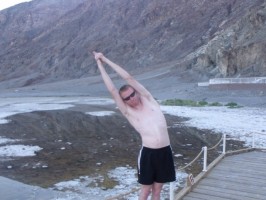
Your author at Badwater performing one of the first postures in the beginner series.
Image Source: trailandultrarunning.com
If you find yourself struggling with overuse injuries, I urge you to consider yoga. Even if you are free from overuse injuries, you will see benefit from yoga in other ways.  I say this having been down that road before.  With an open mind and the right yoga studio, I believe you will quickly find a great balance for your training that will keep you more balanced in body and mind.
Las Vegas entrepreneur Brandie Frommelt is the studio director of Bikram Yoga Westside where she advocates the regular practice of hot yoga for holistic health. For more updates and articles about yoga, follow this Google+ page.

Thursday, March 27, 2014

REPOST: Beginner tips for hot yoga

Because of the notorious pressure cooker atmosphere in the Bikram hot room, It’s completely natural for one to be intimidated when trying out Bikram yoga for the first time. Good thing online fitness magazine Fitsugar offers some pointers to remember when doing Bikram hot yoga as a beginner.
Hot yoga, aka bikram yoga, can be quite intimidating for those who are either new to yoga in general, or haven't been to a hot yoga class before. If the 105ºF temperatures aren't enough to scare you away, the thought of getting sticky and sweating with a group of strangers can be enough to turn you off of it. But, once you get past the heat and the sweat factor, hot yoga classes can provide you with some of the best workouts of your life. Here's what you should know before attending your first hot yoga class. 

Image Source: www.fitsugar.com
  • What to bring: Unlike traditional yoga, hot yoga requires a few more accessories to make the class more enjoyable. I like to bring a big bottle of water so that I can stay hydrated throughout class; my own yoga mat; a slipless yoga towel to help keep me in place during the practice; and a smaller towel for face/neck sweat. Note: towels are not required, but with all of the sweating you do, they are nice to have. 
  • What to wear: I tend to just wear my regular yoga clothes to class which are made out of sweat-wicking materials. I would suggest steering clear of baggy or articles of clothing made out of cotton because anything baggy will just become a nuisance, and cotton actually traps sweat, so you'll feel even more uncomfortable. 
  • What the atmosphere is like: As soon as you walk into class, the sudden temperature change will be a shock to your system. You'll feel like you just stepped foot into the Sahara Desert! Find a place in the room to set up your mat and towel, and within a few minutes you'll acclimate to the temperature. Some men choose to not wear shirts, and sometimes just tiny bike shorts during class, so don't be alarmed if a half-naked man walks in (now for a half-naked woman, that I've never experienced!). I've been to some classes where people are really chatty before and want to talk about the weather, etc., but I actually prefer the classes where it's complete silence beforehand — helping you get your "om" on before the teacher walks in. 
  • The actual class: All hot yoga instructors bring their own flair and style to class. Some teachers use loud, rhythmic music, while some use quiet, meditative music, while some don't use any music at all. And just like other types of yoga, the poses can be really intense and be held longer than others, or quick, like a flow sequence. Remember to keep filling your lungs with air, taking long deep breaths throughout your practice. If you need to stop at any point during the class because you are feeling nauseous or dizzy, make sure you stop and drink some water. And if you need to rest to catch your breath, just go into child's pose and take the time you need before continuing. It's better to go into child's pose and take a break, rather than push yourself to a point that could be potentially harmful. It's normal to feel a bit light-headed during class because of the extreme heat, but if you feel like you're going to faint, naturally you can excuse yourself from the room. I've heard of classes where the teachers forbid you from leaving once the class is started, but first and foremost, you need to take care of you, so if you feel unwell, don't push yourself. Feeling uncomfortable is common, being in unbearable pain is not.
  • The sweat factor: Be prepared to sweat. You're going to drip sweat from places you didn't even know could produce sweat. And if you think you're sweating, just look at how much your neighbor is sweating. Feel free to wipe your face during class with your hand towel if the sweat beads rolling down your face get to be too much. And after class, remember to wipe around your mat for any sweat that escaped your towel zone. 
  • What to expect after class: If I ever drive to class, I take a few moments to drink some water and re-connect with reality before taking to the roads. You may feel light-headed, which is perfectly normal, so don't be afraid to extend your Savasana "the corpse pose" for a few minutes longer, or hang out in the entrance of the studio before continuing on with your day.
Brandie Frommelt is a certified Bikram yoga instructor. Subscribe to this Twitter account for more yoga tips.

Monday, February 17, 2014

Flexibility, Strength, and Good Health


If you value your health, you may want to meet Brandie Frommelt.  Brandie Frommelt is the owner and director of the Bikram Yoga Westside studio in Las Vegas, Nevada where she and her staff are dedicated to helping others build strength and flexibility in order to maintain a good state of health.

http://www.hungryforchange.com/2013/03/exercises-to-lose-weight-with-yoga.php

 Image Source: hungryforchange.com

With more than 20 qualified instructors leading classes 7 days a week and beginning as early as 5:30 in the morning and running as late as 8 in the evening, you are sure to find a teacher and class time that will fit your schedule.  In addition to the camaraderie that you will experience with your instructors and fellow class mates, you will find that after developing your yoga practice on a regular schedule that you will feel stronger as well as better able to rest and sleep at nights.

By tapping into a discipline that has proven its efficacy over the centuries, you can overcome many physical obstacles that slow you down and make your life more difficult.  Even students who are retired or have suffered injuries and ailments that restrict their movements and joints have discovered a new vitality and energy once they take on the Bikram Yoga practice on a frequent basis.

http://www.solsticeyogastudio.com/


Bikram Yoga is also popularly described as hot yoga, as the room is typically heated to as much as 105 degrees Fahrenheit.  As you might imagine, this allows a student to sweat out all kinds of toxins and tends to make the body more flexible than in a cold environment.  This form of practice is intended to benefit the whole body, from muscles and bones to internal organs.  By practicing both postures and breathing methods, you can take advantage of the many benefits connected with each of these exercises.


http://www.eshave.com/blog/bikram-yoga-its-hot-part-3/

 Image Source: eshave.com

If you are already in good health and want to remain so or if you are suffering from physical conditions which limit your activities and may perhaps cause you pain, joining the community at the Bikram Yoga Westside studio could be just the right prescription for an improved and healthier life!

Friday, January 17, 2014

REPOST: What is Bikram Yoga?

In recent years, many people from different age groups have started practicing Bikram yoga to lose weight, reduce stress, and improve flexibility. LiveScience.com explains in detail this type of yoga and its many health benefits.
Image Source: www.livescience.com
Bikram yoga, often called "hot yoga," is a form of yoga popularized by Bikram Choudhury in the 1970s in California. Bikram yoga instructors go through a nine-week training program in which they learn a set practice and dialogue. Currently, there are more than 1,650 Bikram studios around the world.

The yoga practice involves repeating the same 26 poses in set cycles over 90-minute classes. In most classes, rooms are heated, often up to a sweltering 105 degrees Fahrenheit (41 Celsius) and kept at fairly high humidity. Proponents claim the temperature improves blood flow and helps oxygen reach muscle tissue, which may make practitioners more flexible. Hot yoga advocates also say the practice can flush out toxins from the body and even help with weight loss.

Studies have shown that a regular yoga practice can help lessen back pain, sharpen the mind, improve mood and even lower blood pressure. However, no large-scale scientific research has backed up benefits specific to the Bikram practice. Toxins, for instance, are typically flushed out not by sweating, but by the liver and the kidney, and are removed through urination or bowel movements.

However, the practice does have some potential dangers. The profuse sweating involved in Bikram yoga can lead to dehydration if practitioners don't drink enough water. A 2012 study in the British Medical Journal Case Reports described a woman who developed seizures and went into a coma after losing so much salt through profuse sweating in a Bikram yoga class. And the increased flexibility can actually be a bad thing, because it can make practitioners prone to overstretching that can facilitate strains and sprains, according to "The Science of Yoga: The Risks and the Rewards," (Simon & Schuster, 2012).

Hot yoga can also worsen the symptoms of multiple sclerosis, and people with high blood pressure, diabetes, or heart conditions should also steer clear, experts say.

Generally, if someone starts feeling nauseated, dizzy or otherwise ill during a Bikram yoga class, it's a good idea to have some water and take a break.

Still, there's little risk of developing heat stroke during a Bikram yoga class, at least if it's practiced in a room kept between 90 and 95 F (32 and 35 C), according to a small 2013 study by the American Council on Exercise. That study tracked 20 people practicing both hot and regular yoga found virtually no difference in core temperature or heart rate between the two groups.  Those practicing the hot yoga, however, did perceive it to be harder, even if their bodies didn't register the increased difficulty.

Brandie Frommelt is a certified Bikram yoga instructor. Visit this Facebook page to learn more about this workout.

Saturday, December 21, 2013

REPOST: The fantasy, then the fashion

Fashion photographer Tim Walker uses his skills to make mermaids come to life.  Check out this story in this article from The New York Times.
TIM WALKER is a listener, taking in conversational cues and stray bits of wisdom with a mind that whirs incessantly, much like the camera he carries wherever he goes.
And that may be why, as he stood gazing seaward during a shoot last year on the northern coast of England, he was all ears when Kristen McMenamy, his model and muse, confided that she had long been enchanted by mermaids. She told Mr. Walker, as he recalled, “This is the one character I’ve never been able to play,” her wistful confession giving rise to a mutual, and mutually obsessive, fantasy.

Image Source: www.nytimes.com
At the time, the customarily flame-haired Ms. McMenamy wore a silver-gray mane — perfect, she decided, for her imagined role. “I’m not going to cut it until I’ve done the mermaid,” she told Mr. Walker playfully. “So you’d better make it work.”

Their shared vision eventually took shape in a series of eerily unsettling photographs that made their debut in the December/January issue of W. In the fashion portfolio, theoretically conceived to show off a selection of Vionnet dresses, Ms. McMenamy is seen immersed in a giant fish tank; seated at a vanity, a pearl ring through her nose; or resting her tail fin on a homely brass bed.

That shoot was a high point in an annus mirabilis for the British photographer, 43. With the publication of two books, a flurry of high-profile advertising campaigns and a film in progress, he is, as he tells it, only now hitting his stride.

The W shoot began haltingly, too sweet, or alternately too stilted, for his taste. But eventually shooter and model found their rhythm, the experience one of several this year that taught him, he said, “to simply let go, to give in to the uncontrollable force that leads you to do your best work.”

Struck by the fluidity of Ms. McMenamy’s gestures in and out of water, he accompanied his stills with some seven minutes of Super 8 footage, unveiling his mini-film during Art Basel in Miami Beach earlier his month.

An expanded version, now in the editing stage, is the extension of Mr. Walker’s natural proclivities. “His shoots, they don’t start with the clothes,” said Stefano Tonchi, the editor of W, who commissioned the photographs. “They start with an urgency for him to tell a story.”

Which is part of what makes Mr. Walker, among fashion photographers, “the last romantic,” Mr. Tonchi said. In short, “not the kind of guy you can call and say: ‘I have 12 white dresses. Can you shoot them against a blank drop?’ ”

Mr. Walker concurred. “I’m not so motivated by fashion and brands,” he acknowledged by phone from his studio in Brick Lane in East London. Apart from fantasists like the late Alexander McQueen and Rei Kawakubo of Comme des Garçons, he finds little in fashion to sustain him.

“We’ve gone into a super-commercial moment,” he said. “There has never been more fashion, but it’s never been more bland.”

Oddly, his tendency to obscure clothes in favor of elaborately staged, dreamy narratives has only endeared him to the art and fashion set. His works are in the permanent collections of the Victoria & Albert Museum and the National Portrait Gallery in London.

His books, “Tim Walker: Story Teller,” with images like an outsize owl glowering in the corner of an ornate room, or a model dwarfed by a madly grinning doll; and the charmingly dotty “Granny Alphabet,” which introduces a parade of willfully eccentric old ladies, are among this year’s coveted coffee-table volumes. Luxury brands including Dior, Givenchy and Mulberry continue to sign Mr. Walker for ad campaigns, and his fashion work crops up regularly in W and in international editions of Vogue.

True, his fairy-tale interpretations, sugary to the casual eye, can on close study seem downright menacing. “A fairy tale without darkness won’t resonate emotionally,” Mr. Walker said. He takes his own emotional cues from, among others, the spooky work of the 19th- and early 20th-century illustrator Arthur Rackham and uncanny fables of Hans Christian Andersen.

“They get the balance of light and darkness right, and isn’t that the point,” Mr. Walker said.

“Don’t forget, the Little Mermaid has to walk on broken glass.”
Brandie Frommelt is the CEO of Press Talent Management & Development, a talent agency recognized for its stable of models and actors sought by high-profile clients in the entertainment and fashion industry.  Visit this website for more details.

Wednesday, December 18, 2013

Brandi Frommelt Can Help You to Reclaim Your Life with Bikram Yoga


Your friends have been trying to get you to join the “yoga” train, telling you how it helps to relieve stress and provide health benefits.  Yoga, which has become increasingly popular during the past few years, certainly can help you to relax and to see life from a different point of view, but in many cases, it can do more than that: It can give you your life back – literally.  With the help of Brandi Frommelt, director of Bikram Yoga Westside in Nevada, you can discover how Bikram Yoga especially can add to your life.

Image Source: www.bikramyoga.com
Bikram Yoga involves 26 postures that have been proved to keep all parts of the body functioning at their maximum levels.  This type of yoga involves not only your ligaments and muscles but also your veins and internal organs.  A certified Bikram Yoga teacher at Bikram Yoga Westside can introduce you to the various postures that will give your body a renewed sense of vitality – right after you go through one of the studio’s “torture chambers.”

Image Source: www.yoga-bikram.net

A “torture chamber” provides the heating you need in order to perform the postures correctly.  Heat is essential because it softens your body and makes it more flexible, thus allowing you to reshape it properly through Bikram Yoga postures.  Hatha Yoga at the studio specifically flushes away waste products from your organs and glands through the respiratory system, and Bikram Yoga continues this process by enabling you to sweat in order to further cleanse yourself. 

Image Source: www.yoga1foryou.blogspot.com
Bikram Yoga can keep you in good health overall, improving your breathing ability and increasing your chances of living longer.  This type of yoga also has been known to relieve incapacitating pain from herniated discs, thus helping you to overcome debilitating back pain.  Bikram Yoga Westside truly can make you feel like a brand new person so that you stop merely surviving and start living again.